
blog

October 28, 2025
Ultra-Processed Foods and Menopause: Which Ones to Limit (and Which Can Fit?)
Ultra-processed foods (UPFs) are rarely out of the headlines, with studies linking them to weight gain, heart disease and poor metabolic health. When everyday foods such as certain breads, breakfast cereals and flavoured yoghurts are also labelled as UPFs, it’s easy to start questioning your food choices and wondering just how much you need to change.
Midlife can be particularly busy. Between work, family responsibilities and everything else competing for your time, convenience foods can make a real difference to getting meals on the table. Yet the constant warnings about UPFs can leave you wondering whether the very foods making life easier might also be affecting your weight and long-term health.
During menopause, changes in body composition, sleep and appetite can make weight management more challenging. Research has linked diets high in UPFs with increased energy intake, weight gain and poorer cardiometabolic health. However, not all UPFs are nutritionally alike. Some are easy to overeat and offer little nutritional value, while others provide useful nutrients and can help you put together balanced meals.
In the UK, more than half of the calories we eat come from ultra-processed foods. Cutting them out completely isn’t realistic for most people — and may not be necessary. In this article, we’ll explore why some UPFs may make managing appetite and weight more difficult, which ones are worth limiting and which can still fit into a balanced way of eating — so you can make informed choices without sacrificing convenience.
What Are Ultra-Processed Foods (UPFs)?
You may have heard advice such as “avoid anything in a packet” or “if you can’t pronounce the ingredients, don’t eat it”. But these overly simple rules don’t tell us much about a food’s nutritional value.
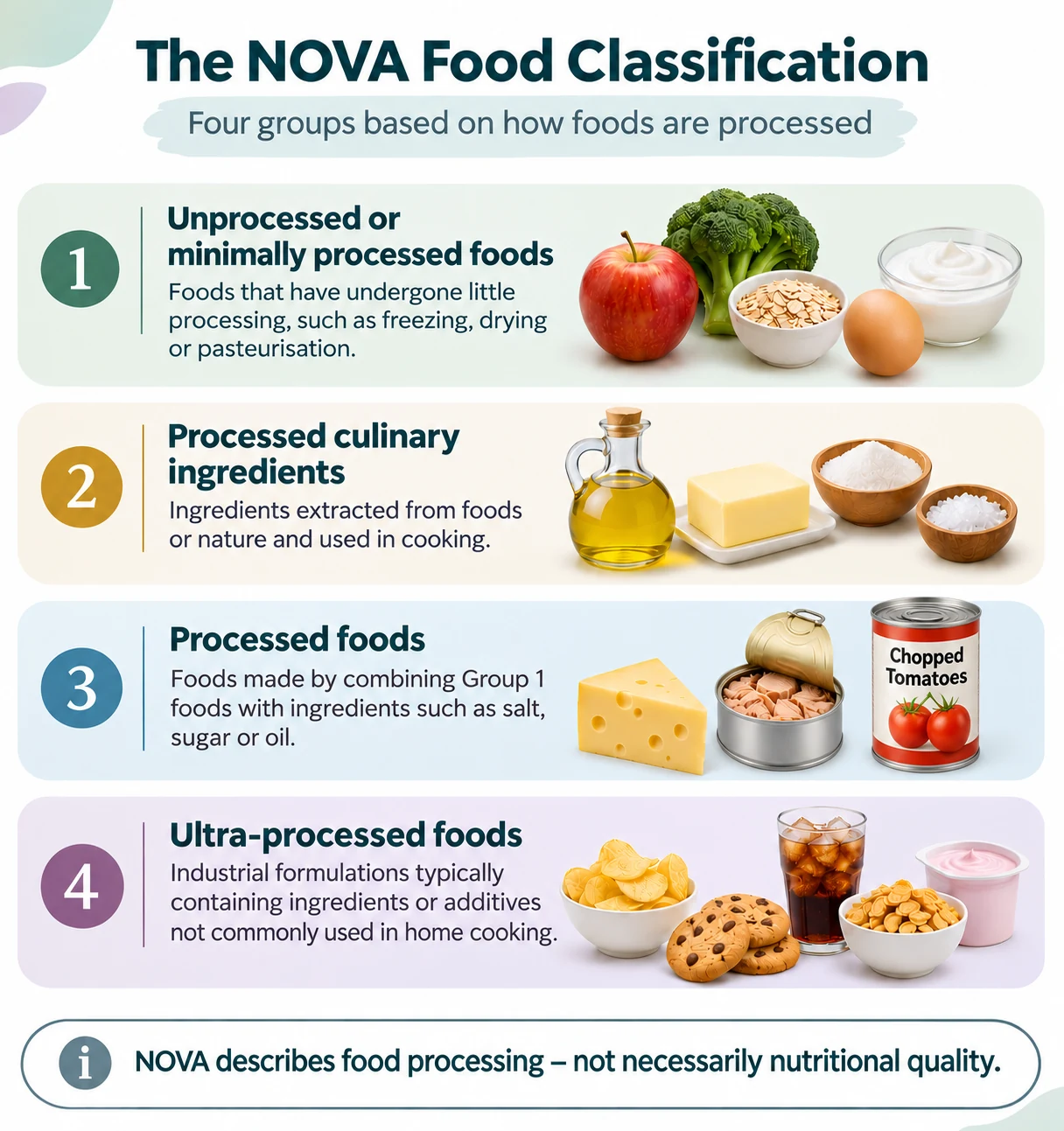
Ultra-processed foods (UPFs) are industrially manufactured products typically containing ingredients or additives that aren’t commonly used in home cooking, such as flavourings, emulsifiers, sweeteners or modified starches.
However, being classified as ultra-processed doesn’t automatically mean a food is nutritionally poor. Crisps, fortified wholegrain breakfast cereals and some plant-based meat alternatives may all be classified as UPFs, despite having very different nutritional characteristics.
Understanding the NOVA classification
The NOVA system was originally developed as a research framework to classify foods according to the nature, extent and purpose of their processing, rather than to judge the nutritional quality of individual foods.
It divides foods into four groups, as illustrated below.
So, what does this mean for your food choices?
Some foods classified as ultra-processed, such as fortified cereals and certain wholegrain breads, can provide valuable fibre, protein, vitamins or minerals. Similarly, baked beans can be a nutritious and convenient option, whether or not a particular product meets the UPF definition.
When managing appetite and weight, it’s helpful to look beyond the UPF label and consider a food’s energy density, protein and fibre content, and how satisfying it is.
Ultra-Processed Foods and Weight Gain: What Does the Research Show?
Many studies have found an association between higher intakes of ultra-processed foods and weight gain. However, much of this evidence comes from observational studies, which cannot establish whether it’s the processing itself that’s responsible, or other characteristics of UPF foods, such as their nutritional composition, energy density (how concentrated in calories they are) or texture.
Controlled studies have helped us understand more about how UPFs may influence how much we eat.
What happens when people eat more UPFs?
In a landmark 2019 study led by Kevin Hall, researchers compared two diets: one made up largely of ultra-processed foods and the other of minimally processed foods.
The meals were designed to be similar in calories offered, protein, carbohydrate, fat, sugar and fibre, and participants could eat as much or as little as they wanted.
The results were striking. When eating the ultra-processed diet, participants:
- Consumed approximately 500 additional calories per day.
- Ate their meals more quickly.
- Gained around 0.9 kg (2 lb) over two weeks, compared with losing a similar amount on the minimally processed diet.
Although this was a small, short-term study involving just 20 adults, it provided experimental evidence that a diet high in UPFs can encourage greater energy intake and weight gain, even when people aren’t deliberately trying to eat more.
However, it doesn’t tell us what happens over longer periods or which particular characteristics of the foods were responsible.
Is it the processing itself that matters?
This is where the research becomes particularly interesting.
Many UPFs have characteristics that can make them easier to overeat. They may be energy-dense, quick to eat or contain combinations of ingredients that make them particularly appealing.
Research has shown that energy density can influence how many calories we consume, even when we eat a similar amount of food by weight. More recent research also suggests that energy density and eating speed can work together to influence energy intake.
However, we’re still learning how much each of these characteristics contributes to the higher energy intake observed with some UPF-heavy diets.
The important point is that the nutritional characteristics and physical properties of foods matter, not simply whether they are classified as ultra-processed.
What does this mean during menopause?
These studies weren’t specifically conducted in midlife women, so we need to be cautious about how we apply their findings to weight management during menopause.
During menopause, changes in sleep, activity and appetite can make weight management more challenging. Changes in body composition, including increased fat around the middle, can also become more noticeable.
If some of the foods you regularly eat make it easier to consume more energy without feeling correspondingly satisfied, this may add to those challenges.
The useful question isn’t simply “Am I eating ultra-processed foods?” but “Which of the foods I regularly eat might be making it harder to manage my appetite and weight?”
Understanding why some UPFs are easier to overeat can help you make more informed choices without needing to eliminate convenience foods altogether.
Why Are Some Ultra-Processed Foods Easier to Overeat?
Not all ultra-processed foods affect our appetite in the same way. Research suggests that several characteristics of foods may influence how much we eat, including their energy density, texture, palatability and nutritional composition.
1. Energy density: how many calories are packed into a food?
Energy density describes how many calories a food provides for its weight. Foods that are high in fat and low in water are often more energy-dense, meaning you can consume quite a lot of calories in a relatively small portion.
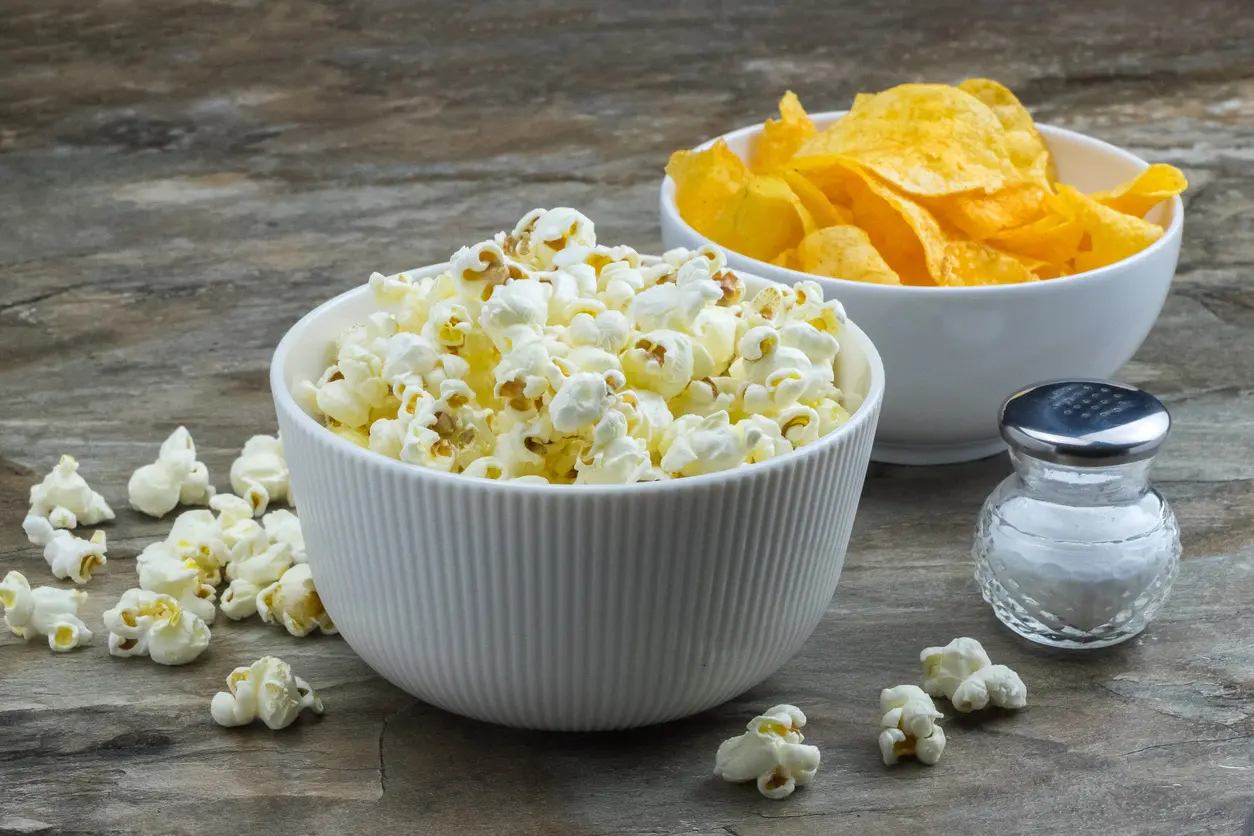
For example, compare a packet of crisps with plain air-popped popcorn (rather than varieties coated in butter or sugar). For a similar number of calories, you can eat a much larger volume of popcorn because it’s considerably less energy-dense. That greater volume may help you feel more satisfied.
This doesn’t mean energy-dense foods are unhealthy. Nuts, seeds and olive oil are all nutritious examples. However, being aware of portion sizes can be particularly helpful when managing weight.
2. Texture and eating speed: how quickly can you eat it?
The physical structure of food can influence how quickly we eat. Soft foods that require little chewing are often eaten more quickly, potentially making it easier to consume more calories before fullness signals have had time to develop.
For example, a soft packaged snack may be eaten in a few bites, whereas an apple requires more chewing and generally takes longer to eat.
This isn’t unique to UPFs — some minimally processed foods are also easy to eat quickly.
3. Palatability: foods that make us want to keep eating
Enjoying food is an important part of eating well. However, some ultra-processed foods contain combinations of fat, sugar, salt and textures that make them particularly appealing and may encourage us to continue eating.
Think about how easy it can be to continue eating crisps, biscuits or chocolate once you’ve started, particularly when you’re tired or distracted.
During midlife, disrupted sleep and busy days can make these situations more familiar, especially when you’re looking for something quick and comforting in the evening.
When we struggle to stop eating these foods, it’s easy to blame ourselves and assume we simply lack willpower. But our response isn’t necessarily a failure of self-control. The characteristics of the food, alongside our hunger, tiredness and eating environment, can all influence how much we eat.
Researchers sometimes describe foods with certain combinations of fat, sugar, salt and refined carbohydrates as hyper-palatable.
Recognising which foods you personally find difficult to stop eating can be more useful than trying to avoid all packaged foods.
4. Protein, fibre and water content: what helps us feel fuller?
It’s not just about what makes foods easy to overeat. Their nutritional composition can also influence how satisfied we feel afterwards.
Foods that provide protein and fibre tend to be more filling, while foods with a higher water content can provide more volume for relatively few calories.
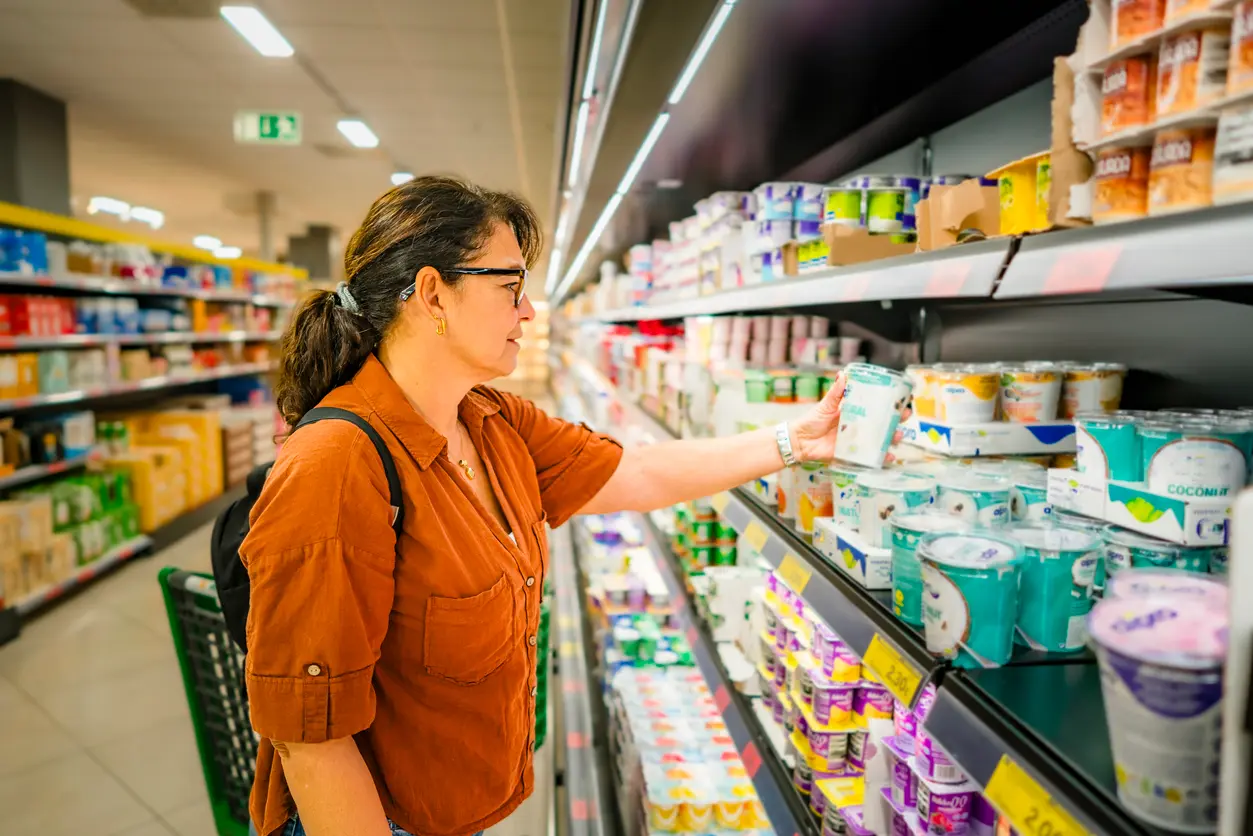
This helps explain why some convenience foods, such as high-fibre wholegrain breads, fortified cereals and higher-protein yoghurts, can still be useful choices, even when they’re classified as ultra-processed.
What matters most?
These characteristics often overlap. A food may be energy-dense, quick to eat and particularly appealing, making it easier to consume more calories than intended.
But not all UPFs share these characteristics, and foods don’t have to be ultra-processed to be easy to overeat.
Rather than judging foods by their processing classification alone, it’s more useful to consider which foods you regularly eat, how satisfying they are and how they contribute to your overall nutrition.
Which Ultra-Processed Foods Are Worth Limiting — and Which Can Still Fit?
For busy women, convenience foods can make it easier to put together balanced meals when time and energy are limited.
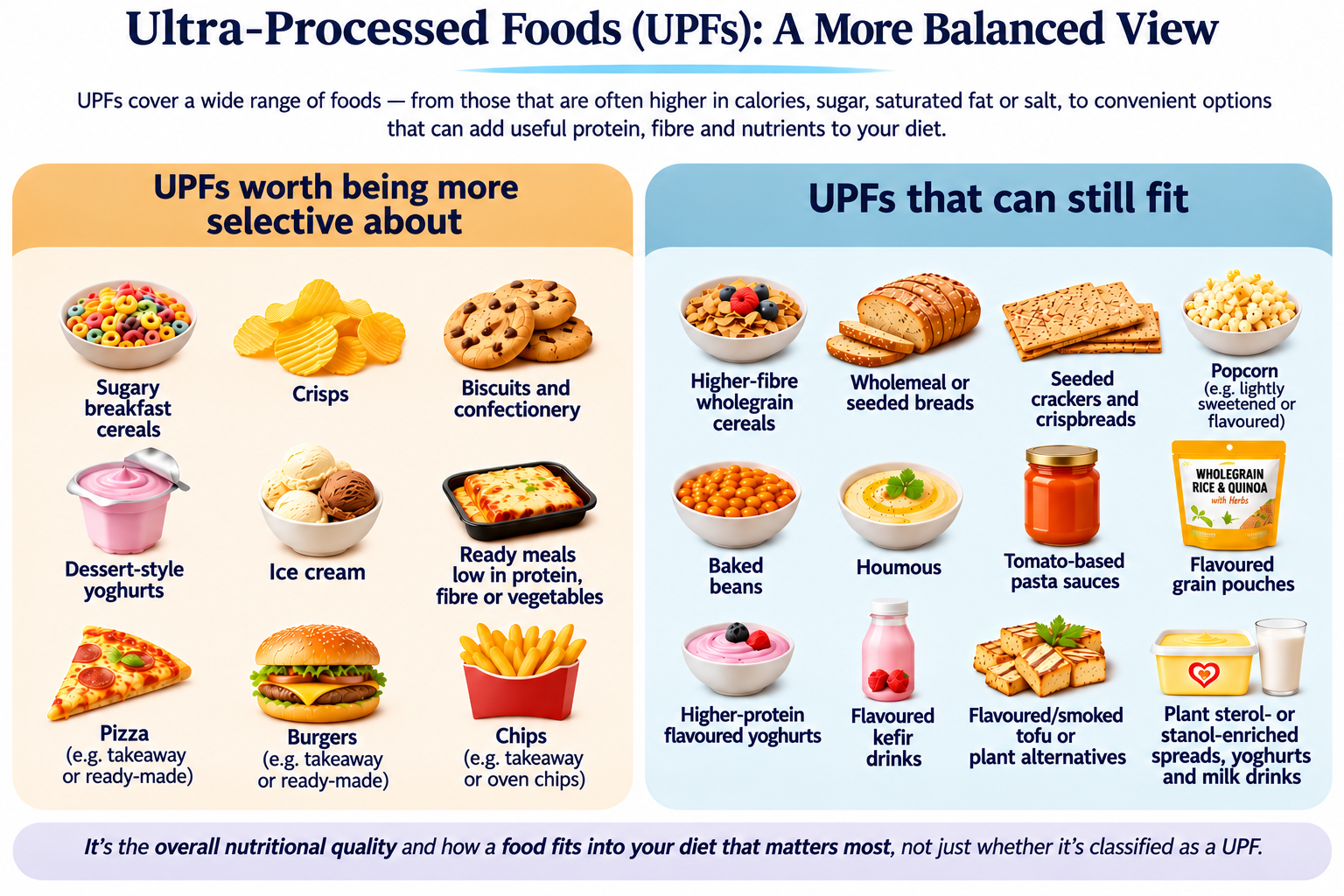
Rather than trying to eliminate all UPFs, it makes more sense to be selective about the foods you eat regularly and consider what they contribute to your overall nutrition.
How should you use this guide?
Think of this as a ‘more often / be selective’ guide, not a rulebook. Portion size and what you pair a food with still matter.
- Worth being more selective about doesn’t mean never. You can still enjoy your favourite foods. Consider how often you eat them, your portions and whether you’re eating them out of habit rather than hunger.
- Can still fit doesn’t mean unlimited. Even nutritious convenience foods vary in their calorie, protein, fibre, added sugar and salt content.
- Look at the bigger picture. What matters is the overall balance of your eating, not whether every food you choose is free from ultra-processing.
Why nutritional quality matters more than the UPF label alone
This distinction is particularly important for cardiovascular health, which becomes an increasing consideration during midlife.
Some wholegrain breads, fortified cereals and other convenient foods can provide valuable nutrients that support heart health, even when they’re classified as ultra-processed.
Consider this example: Someone might replace a plant sterol- or stanol-enriched spread with butter because they see butter as a more ‘natural’ choice. However, butter is considerably higher in saturated fat, and the swap may also mean losing the cholesterol-lowering benefit of the fortified spread when used in effective amounts.
Less processed doesn’t automatically mean healthier. The nutritional composition of a food, and how it fits into your overall eating pattern, matters too.
The same principle applies to weight management. A wholegrain bread might provide fibre but relatively little protein, for example. Pairing it with eggs, cottage cheese or beans can help create a more satisfying meal.
Do You Need to Avoid Ultra-Processed Foods During Menopause?
The short answer is no — but it pays to be selective.
Some UPFs are energy-dense, easy to overeat and provide relatively little nutritional value, while others offer useful nutrients that support a balanced way of eating.
During menopause, when managing weight and cardiometabolic health can become more challenging, choosing foods for their nutritional quality and how satisfying they are is likely to be more useful than trying to eliminate every UPF.
The goal isn’t to eat fewer UPFs at any cost. It’s to make food choices that support your appetite, weight and long-term health, while keeping everyday eating practical and enjoyable.
If you’re wondering where to start, choose one food you eat regularly that doesn’t keep you particularly satisfied. For the next week or two, experiment with adding some protein or fibre, or swapping it for a more filling alternative. Notice whether this makes a difference to your hunger, cravings or energy levels.
Not sure which changes would make the biggest difference for you?
You might already be making plenty of nutritious food choices but still find yourself struggling with hunger, cravings or weight gain during menopause.
Rather than focusing on cutting out more foods, it can be more helpful to understand your everyday eating patterns and identify where small changes could make a meaningful difference.
Take my free quiz to explore your eating patterns and discover a practical place to start.
If you’d like personalised help making changes that work for you, you can also book a free 20-minute discovery call to explore how we could work together.