

blog

August 20, 2025
Creatine for Menopause: Does It Work and Is It Worth Taking?
Creatine for menopause seems to be everywhere at the moment. Once associated mainly with bodybuilders and athletes, it’s now being promoted to women during perimenopause and menopause, with claims that it can improve muscle strength, reduce brain fog and even protect bone health.
But how much of this is supported by scientific evidence? And is creatine really something women in midlife need to consider taking?
The answer is more nuanced than some of the headlines suggest.
The Quick Answer: Is Creatine Worth Taking During Menopause?
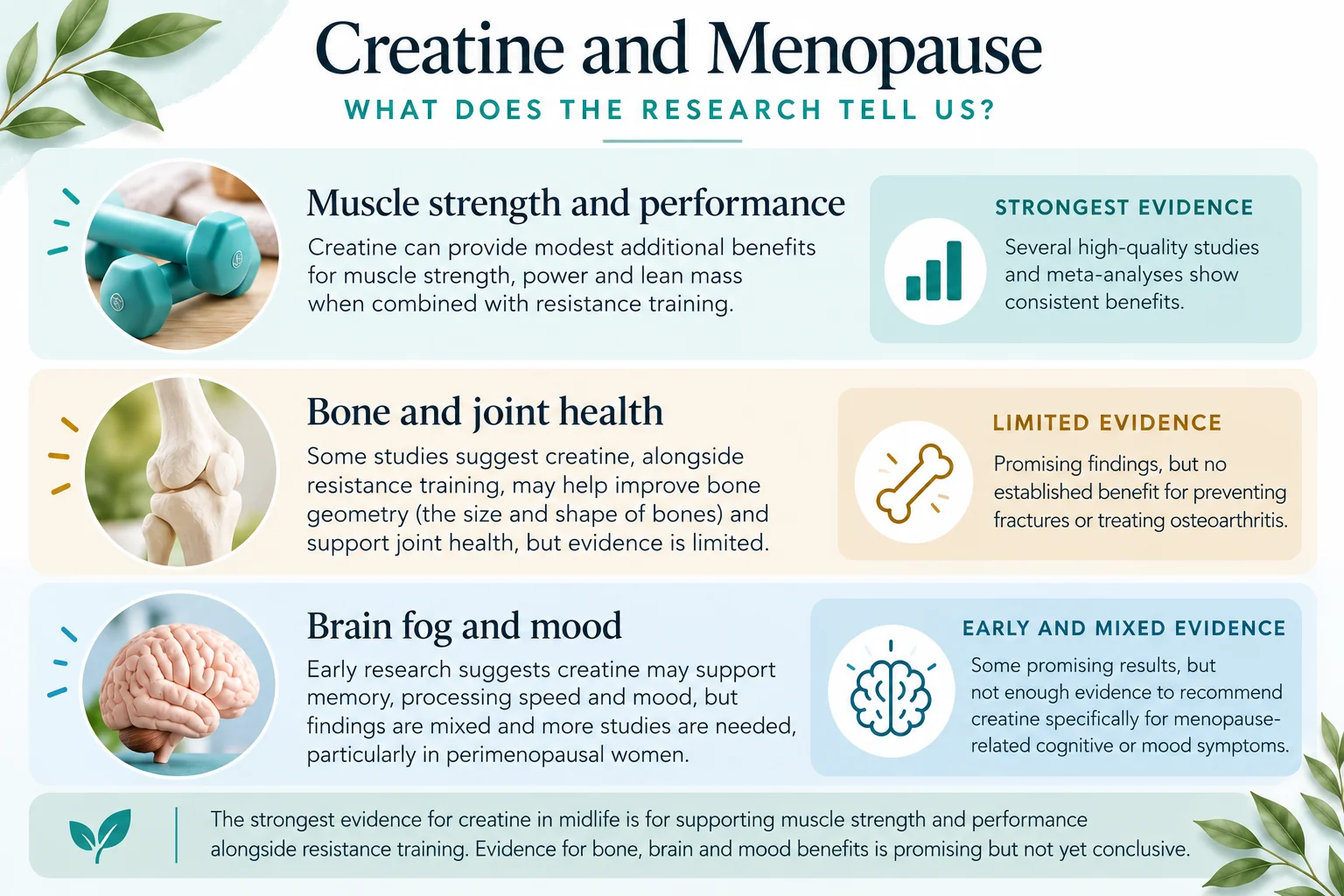
Creatine is one of the most extensively researched sports supplements, with good evidence that it can help improve muscle strength and exercise performance when combined with resistance training. On its own, the benefits for muscle strength and muscle mass appear limited.
For women in midlife, this is potentially valuable. Maintaining muscle strength becomes increasingly important as we age, helping to support physical function, mobility and long-term health.
However, the evidence for other benefits frequently promoted during menopause, including improvements in brain fog, mood and bone health, is much less convincing.
So, while creatine may offer some additional benefits, it isn’t essential for every woman and shouldn’t take priority over adequate nutrition and regular physical activity.
Who Might Benefit Most from Creatine?
Creatine may be worth considering if you’re:
- Already doing resistance training: It may help you gain a little more strength and muscle than training alone.
- Planning to start strength training: It could provide an additional benefit as you build your strength and fitness.
- Vegetarian or vegan: Your dietary creatine intake is likely to be lower, although this doesn’t necessarily mean you’ll benefit more from supplementation.
When Might It Be Less Worthwhile?
If you’re not doing resistance training and aren’t planning to start, the evidence for meaningful improvements in muscle strength or muscle mass from creatine alone is limited.
Similarly, if your main reason for taking creatine is to improve menopause brain fog or protect your bones, the research isn’t yet strong enough to recommend it specifically for those purposes.
What Is Creatine and How Does It Work?
Creatine is a naturally occurring compound that helps your muscles produce energy during short bursts of activity, such as lifting weights or climbing stairs.
Your body makes creatine from amino acids, and you also obtain small amounts from foods such as meat and fish. Most of the creatine in your body is stored in your muscles, although smaller amounts are found in the brain and other tissues.
Creatine works by helping your body rapidly regenerate ATP, the main energy source used by cells. This allows your muscles to maintain their performance during repeated bouts of demanding exercise, potentially helping you train a little harder or complete a few more repetitions.
Over time, these small improvements in training performance may contribute to greater gains in muscle strength and mass when combined with regular resistance training.
What Are the Benefits of Creatine During Menopause?
1. Muscle Strength and Body Composition: The Strongest Evidence
One of the important changes during midlife is the gradual loss of muscle mass and strength that occurs with ageing. Menopause may contribute to these changes, although physical activity, nutrition and ageing itself also play important roles.
Although much of the research has involved postmenopausal women, maintaining muscle strength is important throughout midlife, including during perimenopause.
Maintaining muscle is important for much more than appearance or weight management. It supports everyday strength, mobility, metabolic health and our ability to remain active and independent as we get older.
Resistance training is one of the most effective ways to preserve and build muscle. Creatine may provide an additional benefit by helping muscles perform better during training.
What Does the Research Show?
A recent systematic review and meta-analysis involving postmenopausal women found that creatine supplementation was associated with modest improvements in lean mass and muscle strength. The benefits were most apparent when creatine was combined with resistance training.
- Lean mass: Women taking creatine gained, on average, approximately 0.4 kg more lean mass than women in the comparison groups.
- Muscle strength: In studies measuring leg-press strength, women taking creatine could, on average, press approximately 7.5 kg more weight than women in the comparison groups.
These findings are encouraging. Although the additional gains are modest, improvements in strength may help support everyday activities such as climbing stairs, carrying shopping and getting up from a chair.
It’s worth knowing that an additional 0.4 kg of lean mass doesn’t necessarily mean 0.4 kg of new muscle. Creatine also increases the amount of water stored inside muscle cells, which can contribute to the changes measured in studies.
The findings are averages from a relatively small number of studies, particularly for muscle strength, so individual results will vary.
What Does This Mean for Women During Menopause?
If you’re already doing resistance training, creatine may help you get a little more from your efforts. However, taking creatine without resistance training is unlikely to produce meaningful improvements in muscle strength or muscle mass.
The priority remains regular strength training, supported by adequate protein and overall nutrition. Creatine is an optional addition that may help enhance the benefits of training, rather than replace it.
2. Bone and Joint Health: Promising, but Limited Evidence
Bone health becomes particularly important during and after menopause. Falling oestrogen levels accelerate bone loss, increasing the risk of osteoporosis and fractures.
Researchers are interested in whether creatine might help protect bone health in two ways. By supporting muscle strength, it may help women get more benefit from exercises that strengthen bones. Early laboratory research also suggests creatine may influence the activity of bone-building cells, although it’s not yet clear whether this translates into meaningful benefits for bone health in women.
However, research findings so far have been mixed.
In a two-year study involving postmenopausal women, creatine combined with an exercise programme helped preserve certain aspects of bone structure around the hip. However, it did not improve bone mineral density — the measure commonly used to assess osteoporosis risk.
Although interesting, we don’t yet know whether these changes in bone structure translate into fewer fractures.
There is also some early research into creatine and osteoarthritis. A small study involving postmenopausal women with knee osteoarthritis found that adding creatine to strengthening exercises improved physical function and quality of life compared with exercise alone. However, larger studies are needed before we can draw firm conclusions.
What does this mean for women during menopause?
There isn’t currently enough evidence to recommend creatine specifically for preventing osteoporosis or treating osteoarthritis.
For bone health, the priorities remain regular resistance training, appropriate weight-bearing activity and adequate nutrition, including sufficient protein, calcium and vitamin D. These have a much stronger evidence base than creatine supplementation alone.
3. Brain Fog and Mood: Early but Interesting Research
Brain fog is a common experience during perimenopause and menopause, with many women noticing changes in their memory, concentration and mental clarity.
Because creatine plays a role in energy production in the brain, researchers are exploring whether supplementation might help support cognitive function and mood.
What does the research show?
A 2025 study involving 36 perimenopausal and postmenopausal women reported improvements in reaction time and increased brain creatine levels. However, the study was small and used forms of creatine other than the standard creatine monohydrate. We therefore can’t assume these findings would apply to creatine monohydrate or translate into noticeable improvements in everyday brain fog.
A more recent study involving 51 perimenopausal women investigated creatine monohydrate alongside resistance training. It reported some improvements in sleep consistency and measures of brain activity, but creatine did not produce significantly greater improvements in cognitive test performance than placebo.
Other research has explored creatine during sleep deprivation. In one small study, a single high dose of creatine monohydrate improved certain aspects of cognitive performance and reduced fatigue in sleep-deprived adults.
This is interesting given how frequently sleep disruption affects women during menopause. However, benefits during sleep deprivation don’t necessarily mean creatine will improve everyday menopause brain fog. The dose used was also considerably higher than the usual 3–5 g daily dose for muscle health and should not be taken as a recommendation.
Research into mood is similarly preliminary. A small trial involving women with depression found that adding creatine monohydrate to antidepressant treatment improved symptoms compared with antidepressant treatment alone. However, this wasn’t a study of menopause-related mood changes.
What does this mean for women during menopause?
Although the research is encouraging, there isn’t currently enough evidence to recommend creatine specifically for menopause brain fog, memory difficulties or low mood.
If brain fog is troubling you, it’s also worth considering other contributing factors, including poor sleep, low iron or vitamin B12 levels, thyroid problems and mood changes. Creatine shouldn’t replace identifying and addressing these issues.
How to Take Creatine During Menopause
If you decide creatine is worth trying, the good news is that supplementation is relatively straightforward. You don’t need an expensive specialist product or a complicated dosing routine.
Which Type of Creatine Is Best?
Creatine monohydrate is the best choice. It’s the most extensively researched form, with good evidence for its effectiveness and safety.
Although other forms, including creatine hydrochloride, are marketed as being better absorbed or more effective, there isn’t convincing evidence that they offer advantages over creatine monohydrate.
Choose a plain creatine monohydrate powder from a reputable manufacturer, ideally one that uses independent third-party testing to check product quality and purity.
How Much Creatine Should Women Take?
For most healthy adults, 3–5 g of creatine monohydrate daily is a commonly used dose.
Taking creatine consistently allows the amount stored in your muscles to increase gradually, typically reaching near-saturation after around three to four weeks.
There’s no established menopause-specific dose, and taking more isn’t necessarily better.
When might you notice a difference?
Creatine isn’t something you’ll necessarily feel working straight away. Although muscle creatine stores typically increase over several weeks, noticeable improvements in strength or exercise performance may take longer and will depend on your training programme. Changes in muscle mass generally take longer still.
Do You Need to Load Creatine?
No. Some sports supplementation protocols use a loading phase of around 20 g daily for five to seven days, followed by a lower maintenance dose.
This increases muscle creatine stores more quickly, but it isn’t necessary for most women.
Taking 3–5 g daily will achieve a similar increase in muscle creatine stores over several weeks, with less likelihood of digestive discomfort.
When Is the Best Time to Take Creatine?
Timing doesn’t appear to make a meaningful difference for most people.
You can take creatine before or after exercise, or at another convenient time of day. The most important factor is taking it consistently, including on days when you aren’t exercising.
Creatine monohydrate powder can be mixed into water, milk, yoghurt or other foods and drinks. Taking it with a meal may help if you experience digestive discomfort.
Will Creatine Make You Gain Weight?
You may notice a small increase on the scales when you first start taking creatine.
This happens because creatine increases the amount of water stored inside muscle cells. It’s not the same as gaining body fat.
For women who are monitoring their weight, it’s helpful to understand this distinction so that an early change on the scales isn’t mistaken for an increase in fat.
Not everyone experiences a noticeable weight change, and the amount varies between individuals.
Is Creatine Safe During Menopause?
Creatine monohydrate is one of the most extensively studied sports supplements and is generally considered safe for healthy adults when taken at recommended doses.
Research involving both younger and older adults has not found evidence that standard doses of creatine damage healthy kidneys.
However, as with any supplement, there are some things worth considering before you start taking it.
Does Creatine Affect Kidney Health?
Research has not found evidence that creatine damages healthy kidneys when taken at recommended doses.
However, creatine can affect the interpretation of kidney function blood tests. This is because some creatine is naturally converted into creatinine, a substance measured in blood tests to help assess kidney function. Taking creatine supplements can sometimes increase creatinine levels without indicating kidney damage.
If you’re having a blood test, let your GP or healthcare professional know you’re taking creatine so they can interpret your results appropriately.
If you have an existing kidney condition or reduced kidney function, it’s sensible to discuss creatine supplementation with your GP or kidney specialist before taking it.
Are There Any Side Effects?
Most people tolerate creatine monohydrate well, particularly at the usual dose of 3–5 g daily.
Possible side effects include:
- Digestive discomfort: Some people experience bloating, nausea or loose stools, particularly with larger doses. Taking creatine with food may help.
- A small increase in weight: Creatine increases water stored within muscle cells. This isn’t an increase in body fat, as explained earlier.
There is no convincing evidence that creatine causes dehydration or muscle cramps when taken at recommended doses, although it’s still important to maintain normal hydration.
Who Should Check Before Taking Creatine?
Although creatine is generally safe for healthy adults, it’s sensible to seek medical advice before starting if you:
- Have kidney disease, reduced kidney function or a history of significant kidney problems.
- Have a complex medical condition or take medications that could affect kidney function.
If you’re taking prescribed medication and are unsure whether creatine is suitable for you, check with your GP or pharmacist. Don’t stop or change any prescribed medication in order to take a supplement.
Frequently Asked Questions About Creatine and Menopause
Can I Take Creatine if I’m Trying to Lose Weight?
Yes. Creatine doesn’t prevent weight loss or cause an increase in body fat.
If you’re trying to lose weight, maintaining muscle mass is particularly important. Resistance training, adequate protein and an appropriate energy intake are the main priorities, but creatine may offer a small additional benefit when combined with strength training.
Remember that creatine can initially increase water stored within your muscles, so changes on the scales may not always reflect changes in body fat.
Is Creatine Safe if I Have High Blood Pressure?
Research hasn’t shown that creatine monohydrate consistently increases blood pressure in healthy adults taking standard doses.
However, research specifically involving women with hypertension is limited. If you have high blood pressure, particularly if it’s poorly controlled or you also have kidney problems, it’s sensible to check with your GP before starting creatine.
Creatine isn’t a treatment for high blood pressure and shouldn’t replace prescribed medication or lifestyle measures.
Should I Stop Taking Creatine Before a Blood Test?
Not necessarily. However, it’s important to tell your GP or healthcare professional that you’re taking creatine, as it can affect how some kidney function results are interpreted.
If necessary, your GP can advise whether to pause supplementation or arrange additional tests.
How Long Does Creatine Take to Work?
Taking 3–5 g daily typically increases muscle creatine stores over approximately three to four weeks.
However, noticeable improvements in exercise performance or strength may take longer and depend on your training. Changes in muscle mass generally take longer still.
Do I Need to Take Creatine Every Day, Including Rest Days?
Yes, if you choose to supplement, the usual approach is to take creatine daily, including on days when you aren’t exercising.
Creatine works by gradually increasing the amount stored in your muscles, rather than providing an immediate boost when you take it.
Does Creatine Cause Hair Loss?
There’s currently no convincing evidence that creatine supplementation causes hair loss.
This concern largely originated from a small study involving male rugby players, which reported an increase in a hormone associated with hair loss. However, the study didn’t actually measure hair loss, and subsequent research hasn’t established that creatine causes it.
Hair thinning can occur during menopause for several reasons, including hormonal changes. If you’re experiencing noticeable hair loss, it’s worth discussing possible causes with your GP rather than assuming a supplement is responsible.
Do Vegetarian and Vegan Women Benefit More From Creatine?
Vegetarian and vegan diets generally provide little or no dietary creatine because its main food sources are meat and fish.
Some research suggests that people following these diets may have lower muscle creatine stores and experience a greater increase in those stores when supplementing.
However, this doesn’t necessarily mean vegetarian or vegan women will gain more muscle or strength from taking creatine. The evidence for a greater training benefit is less consistent.
Creatine monohydrate supplements are generally suitable for vegetarians and vegans, although it’s worth checking the product ingredients.
The Bottom Line: Is Creatine Worth Taking During Menopause?
Creatine monohydrate is one of the few supplements with good evidence for supporting muscle strength and exercise performance, particularly when combined with resistance training.
For women during and after menopause, this may offer a modest additional benefit at a time when maintaining muscle strength is increasingly important for long-term health.
However, the evidence for improving brain fog, mood, bone health and joint health remains limited. Despite some promising research, creatine isn’t currently a supplement I’d recommend specifically for these concerns.
My advice? Focus on the foundations first. Regular resistance training, adequate protein and good overall nutrition will make a much greater difference to your long-term health than any supplement alone.
If you already have these foundations in place, creatine monohydrate may be worth considering as an optional addition. But it’s certainly not something every woman needs to take.
Looking Beyond Supplements?
If you’re also wondering why your weight or body composition is changing during midlife, you may find my article Menopause Weight Gain: Why It Happens and What to Do helpful.
It explores the changes that occur during menopause and the practical steps you can take to support your weight and long-term health.